Electricity is the invisible force that powers our modern lives, but not all electricity is the same. When you plug a lamp into a wall socket, you’re using a different type of power than what your smartphone uses to charge its battery. This is the fundamental difference between AC and DC power.
Understanding alternating current vs direct current is not just for electricians. It explains why we need bulky power bricks for our laptops and small adapters for our phones. It is the key to understanding how our devices work safely without getting fried by the raw power from the grid.
Let’s demystify these two types of electrical currents and explore why this “battle of the currents” still matters today.
What Is AC Power?
AC stands for Alternating Current. This is the type of electricity that comes out of the wall outlets in your home. The term “alternating” refers to the fact that the flow of electric charge periodically reverses direction.
Imagine a saw cutting through wood. It moves back and forth rapidly to get the job done. AC power behaves similarly. The electrons in the wire don’t just flow in one direction; they vibrate back and forth, changing direction 50 or 60 times per second (known as the frequency, measured in Hertz).
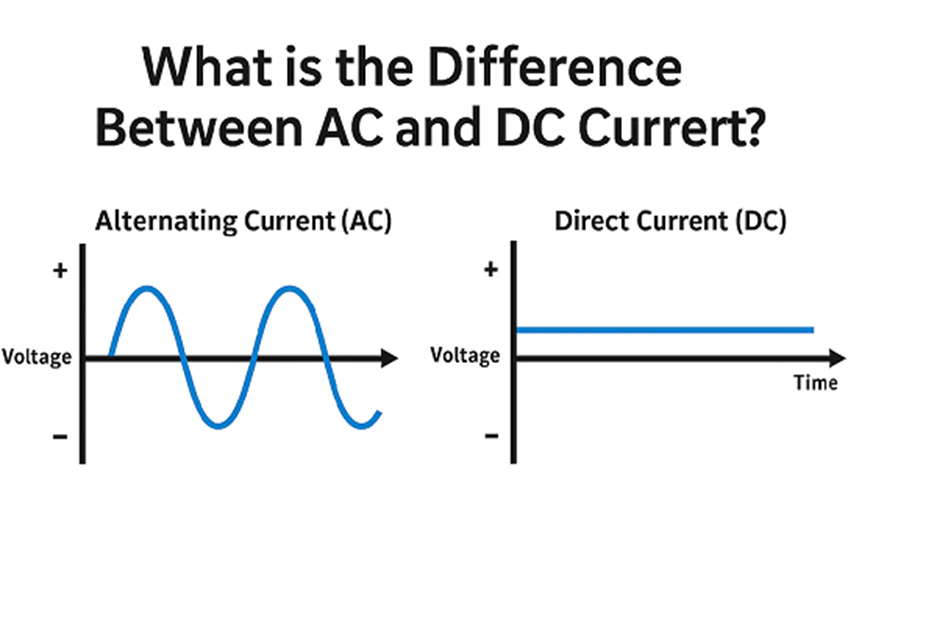
Conceptual Diagram: Picture a wavy line (a sine wave) moving forward. The line goes up above a central point and then down below it, repeating this pattern continuously. The upward curve represents the current flowing in one direction and the downward curve represents it flowing in the opposite direction.
This ability to change direction and voltage with the help of transformers makes AC power incredibly efficient for long-distance transmission. Power plants can generate electricity at very high voltages, send it across the country with minimal energy loss and then step it down to a safer voltage for household use.
Common Devices Using AC
AC power is ideal for devices with motors, heating elements and other components that can use this back-and-forth flow of energy directly.
- Refrigerators: The compressor motor runs on AC power.
- Washing Machines: The motor that spins the drum uses AC.
- Lamps: Traditional incandescent and fluorescent lights work by heating a filament or exciting gas, which AC is perfectly suited for.
- Toasters and Blenders: These appliances use AC to power their heating elements and motors.
What Is DC Power?
DC stands for Direct Current. Unlike AC, this type of electricity flows in a single, constant direction.
Think of it like water flowing through a hose. Once you turn the tap on, the water moves from one end to the other in a steady, straight line. DC power provides this same kind of stable, consistent energy flow.
- Conceptual Diagram: Imagine a straight, flat line moving forward. It remains at a constant level without any waves or dips, representing a steady flow of voltage in one direction.
DC is the language of modern electronics. It’s stored in batteries and is essential for powering anything with a circuit board, microchip or processor.
Common Devices Using DC
Anything portable or that contains sensitive digital components will almost always run on DC power.
- Smartphones and Tablets: Their internal components and batteries are all DC-based.
- Laptops: The computer itself runs on DC, which is why it has a large power brick to convert AC from the wall.
- LED Lights: These are semiconductors that require a steady, one-way current.
- Electric Vehicles: The large battery packs store and deliver DC power to the motors.
- Anything with a battery: From your TV remote to a handheld gaming console, if it has a battery, it uses DC.
Why Electronics Use DC Power
The simple reason electronics rely on DC power is stability. Digital circuits are built from billions of tiny transistors that act as microscopic on/off switches. These switches create the ones and zeros of binary code, which is the foundation of all digital information.
To work reliably, these transistors need a smooth, unwavering voltage. The fluctuating nature of AC power would be like trying to have a conversation during an earthquake—the information would get jumbled and corrupted. The constant, predictable flow of DC ensures that the voltage remains stable, allowing the microchips to process data accurately and without errors.
Feeding high-voltage, alternating current directly into a sensitive processor would instantly destroy it. DC provides the gentle, steady stream of energy that these delicate components need to function.
How Power Adapters Convert AC to DC
Since your wall provides AC but your phone needs DC, there has to be a translator in between. That’s the job of a power supply, also known as an AC/DC adapter. That little block you plug into the wall performs a critical conversion process in a split second.
Here’s a simplified breakdown of what happens inside:
- Transformation: The adapter first takes the high-voltage AC from the wall (e.g., 230V) and uses a transformer to step it down to a much lower, safer voltage (e.g., 5V or 12V).
- Rectification: Next, the now low-voltage AC is passed through a rectifier, which acts like a one-way gate. It blocks the current from alternating, forcing it to flow in a single direction.
- Filtering: The current is now DC, but it’s a “bumpy” or pulsating DC. The adapter uses capacitors to smooth out these pulses, creating a much steadier flow.
- Regulation: Finally, a regulator circuit ensures the output voltage is perfectly constant, protecting your device from any fluctuations from the power grid.
The result is a clean, stable DC output that can safely power your electronics or charge their batteries.
Choosing the right adapter is crucial for the health of your devices. A well-designed power supply ensures efficiency and safety. As experts in power conversion, Campad Electronics offers a wide variety of high-quality power supplies to meet the needs of countless electronic devices. You can explore their range to find reliable solutions for everything from routers to specialized equipment.
Whether it’s the AC powering your home or the DC charging your phone, both currents play an essential role in our electrified world.